


Pune Grand Cycling Tour

Never mind the raging discussions about the heightening pollution across India. The Pune Bajaj company sponsored Grand Tour 2026 became a big hit with an large participation of cycling teams from across the world.
The just concluded Bajaj Pune Grand Tour 2026, (between 19th & 23rd January 2026) was India’s first-of-its-kind cycling challenge that invited global cycling enthusiasts to cycle through the Gateway of Deccan Plateau. An initiative by District Pune, this marquee cycling event aimed to promote the rich geographical diversity of the region and introduce the world to Pune’s culture.

The Bajaj Pune Grand Tour 2026 was planned across 437 kilometres, split across 4 stages. The idea was to present multiple challenges to the cyclists and, at the same time, take them through the hills, rivers, grasslands, and the rich cultural history of the place. This also helped put Pune District on the global tourism map for its natural and cultural richness.
Bajaj Pune Grand Tour 2026 has the designs to make Pune, India’s Next Global Cycling & Tourism Hub.
According to the intensive coverage given to the event Luke Mudgway of Li Ning Star, China, won the opening road stage of the Pune Grand Tour 2026 , claiming the Mulshi-Maval Miles after an 87.2km race decided by a sprint finish.
Mudgway, who hails from New Zealand, stopped the clock at 2 hours 21 seconds, edging out Andreas Matildas of Estonia’s Quick Pro Team, who finished second in 2:00:27, with Belgium’s Yorben Lauryssen of Tarteletto-Isorex third in 2:00:30.
Under UCI regulations for 2.2 stage races, the top three finishers earned time bonuses of 10, six and four seconds, respectively, giving Mudgway an early advantage in the general classification.
“It was really fast from the start,” Mudgway said. “I stayed near the front, especially over the first categorised climb. After that there were two or three groups, and I just sprinted for the finish. I had two teammates there who helped me, so I’m happy I could finish it off for the team.”
The race also had its own thrills. The race was neutralised for approximately 23 minutes shortly after the first intermediate sprint following an on-road incident involving riders in the second group of the peloton.
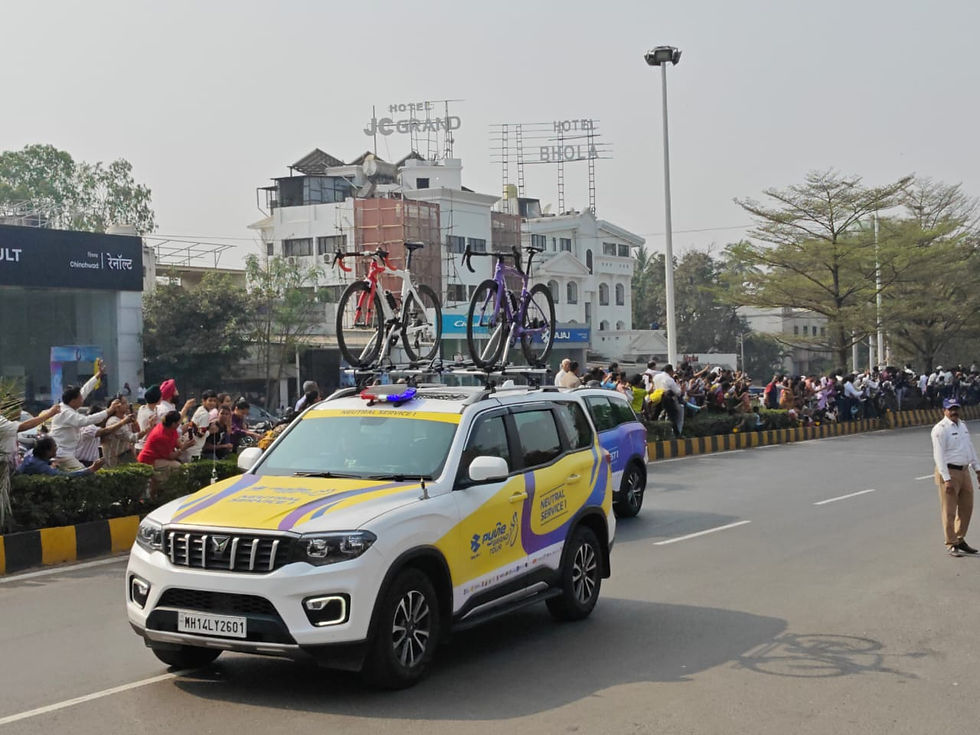
Under UCI safety protocols, officials temporarily suspended the stage while medical teams attended to affected riders and mechanics addressed damaged bicycles.
The Indian Express Newspaper wrote, Pune has not been called the “Cycle City” for many decades. The gentle bicycles that defined it in the 1960s and 1970s have long been edged out by a snarling fleet of over 72 lakh vehicles that choke its roads daily. The cycle tracks the city had demarcated some years ago on its roads have all but disappeared.
So when news broke a few months ago that Pune would host a world-class international cycling event on its notoriously potholed roads, it met with more skepticism than celebration. Four months later, the city has seemingly silenced the doubters.
The race that commenced on January 19, is the biggest UCI 2.2-level race in the world. A 2.2-level UCI race is basically the entry-level race organised by the UCI, the global body governing cycle races. Points participants earn here count towards Olympic qualification.
The Pune edition, with 171 participants and 29 teams from 35 countries, not only surpasses the general average of 125 participants for a UCI 2.2 race but also breaks the earlier record of 144 participants.

In the run up to the races, Pune administration approached the Cycling Federation of India in June 2025, who immediately got into action, given that the UCI application deadline was just a week away. The carefully put together presentation highlighted the route through the picturesque and hilly landscape of Mulshi, Maval, Rajgad and Purandar against the backdrop of heritage sites, villages, and ghats. It proved to be a clincher and the UCI committee that met in Rwanda in September unanimously gave the go-ahead to the proposal.
With pollution being a major concern, the administration has also been pushed to address that with some short-term measures and long-term plans of removing vehicles beyond a certain age from the roads as well as installing AQI meters producing live feed data from construction sites.
In the rural areas, where 310 kilometres of the cycle route lie, about 130 villages now have world-class roads. It is hoped that this connectivity will boost agriculture, small-scale industries and agro-tourism, other than enabling farmers to transport their produce quicker, avoid wastage and get better prices.

The message being sent out by the Pune stakeholders is that sports can be a great trigger to deliver time-bound infrastructure of top quality, so cities should identify games as per their strength and host them. With India mulling hosting Olympics someday, the Pune event is certainly a big morale booster.
Thothathri Raman with Manoj Patil & Sangeetha Sanjay at Pune.


Comments